

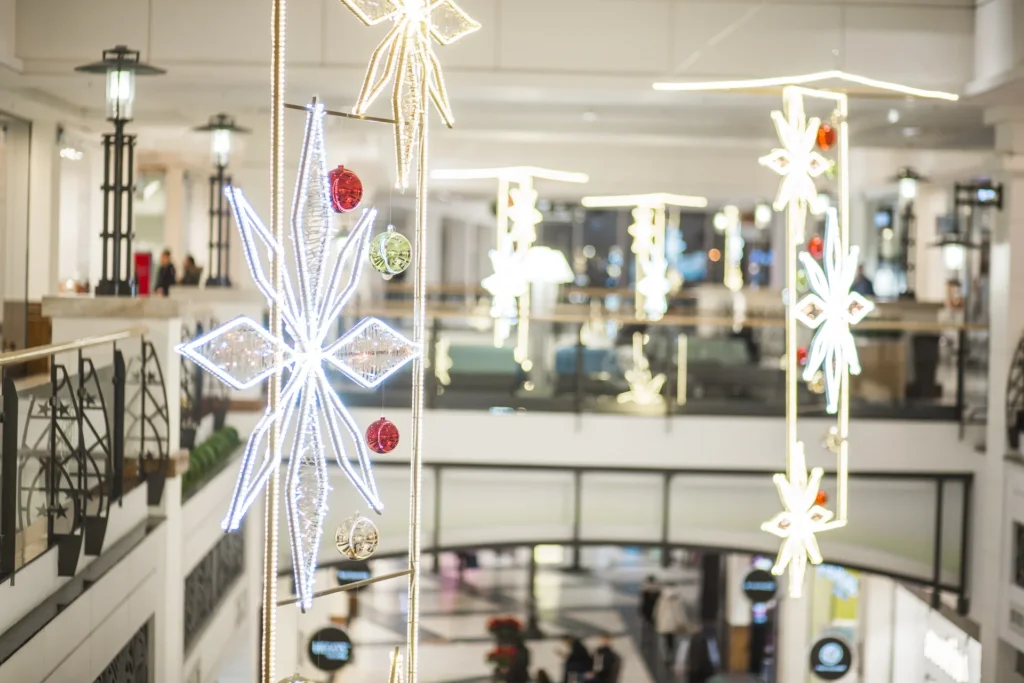
A seasonal display is not just an addition to the décor. It’s a tool with a clear purpose: to attract people to a venue, encourage them to stay longer, guide them through the space and give them a reason to return. That’s why planning decorations for a shopping centre should start with the floor plan and the goals the display needs to achieve—not with a catalogue. In this article, we explain how to plan decorations for different areas of a shopping centre, what to consider from a technical perspective and how to create a schedule that gets everything ready before the season.
Why Do Shopping Centres Need Seasonal Decorations?
A well-designed display can support a venue’s business goals. The most common objectives include:
- Footfall — a distinctive display gives visitors another reason to choose your shopping centre.
- Dwell time — photo spots, family areas and interactive decorations encourage visitors to stay longer.
- Traffic throughout the centre — decorations along the walkways encourage people to explore different areas instead of gathering only in the entrance atrium.
- Social media reach — a photo by the Christmas tree or beneath an illuminated chandelier provides free promotion for the centre.
- Brand recognition — a cohesive display repeated each year can become part of the venue’s identity.
It’s worth defining these objectives at the outset. They help determine where to place a focal installation, how many photo spots to include and how much of the budget to allocate to decorations that guide visitors through the space.
Shopping Centre Zones: What to Plan and Where
Each part of a shopping centre serves a different purpose. Here’s a map to help you get started.
| Area | Purpose | Tried-and-tested solutions |
|---|---|---|
| Car park, entrances and lamp posts | First impressions and visibility after dark | Lamp-post motifs, flagpole decorations and entrance gateways |
| Façade and entrances | Recognition from a distance | Outline lighting, illuminated lettering, LED curtains, 2D motifs and façade installations |
| Atrium | A focal point, meeting place and event space | Giant Christmas trees, chandeliers and suspended decorations, 3D figures and scenography |
| Walkways and circulation routes | Guiding visitor flow and creating a cohesive theme | Overhead decorations, lettering, repeating motifs and suspended displays |
| Photo spots and family areas | Dwell time, photos and engagement | 3D figures, tunnels, interactive decorations and oversized illuminated lettering |
Entrances, Car Parks and Façades: Decorations That Work Before Visitors Enter
A display can make an impact before visitors even enter the building. Decorations on car park lamp posts, flagpoles and entrance gateways create a strong first impression and increase the venue’s visibility after dark. On façades, outline lighting, lettering and LED curtains work well when designed to complement the architecture and remain clearly visible from a distance, for example from an access road.

The Atrium: The Heart of the Shopping Centre
Most visitors pass through the atrium, which also becomes a meeting place and event space during the shopping season. One striking decoration can do more here than many smaller elements scattered throughout the walkways. The most effective choices for an atrium include:
- A giant Christmas tree — the main symbol of the season. Choose its design, height and decorations to suit the scale of the atrium, from regular cone-shaped trees to branch-style and trunk-style designs. Our giant Christmas trees range from 4 to 20 metres tall.
- Large freestanding decorations and 3D figures — focal installations that naturally become photo spots.
- Elaborate seasonal scenography — ideal when the centre wants to tell a story rather than simply display a single feature.
Suspended Decorations: Use the Height, Not the Floor Space
Floor space is one of a shopping centre’s most valuable assets, so it makes sense to use the vertical space. Illuminated chandeliers, spheres, stars, cascades and complete three-dimensional compositions suspended above atriums and walkways create impact without taking up space needed by tenants and visitors. A large chandelier in the atrium can be seen from several levels at once, making an impression throughout the centre.
Walkways: A Rhythm That Guides Visitors
Overhead decorations, lettering and repeating motifs can mark entrances, guide visitor flow and bring the display together under one theme. They’re also effective for seasonal messaging or centre branding. Extending the decorations beyond the atrium gives visitors a reason to explore further.
Photo Spots and Interactive Decorations
A photo spot works best as part of a route, rather than as an isolated feature in a corner. 3D figures, light tunnels and oversized illuminated lettering featuring the shopping centre’s name naturally invite visitors to take photos. Interactive decorations that respond to movement, touch or sound can hold visitors’ attention for minutes rather than seconds—particularly in family areas.
Project Example: Plaza Rybnik in a Christmas Setting
At Plaza Rybnik, the goal was to create a complete seasonal display for the centre’s key areas: entrances, walkways, seating areas and high-traffic zones. The design needed to complement the architecture and the centre’s brand identity. We began by auditing visitor routes and planning interactions. This informed the visual hierarchy of the display: focal installations, walkway decorations and the visitor journey.
The display featured chandeliers, overhead decorations, façade lighting and a Cone Christmas tree. Its standout feature is a walk-through passage inside the tree, finished in red. The contrast with the tree’s illumination makes it visible from a distance. The installation outside the shopping centre uses a safe low-voltage system, and work was scheduled between 10 pm and 6 am to avoid disrupting the venue. The project included design, production, installation, maintenance, dismantling and storage.
Beyond Christmas: A Year-Round Calendar of Shopping Centre Decorations
Christmas is the peak season, but shopping centres are increasingly planning displays throughout the year. Each occasion is an opportunity to refresh the space and create a new photo spot:
- Valentine’s Day — hearts, light tunnels, lettering and photo spots that create natural places to meet and take pictures.
- Easter — Easter eggs, rabbits, floral arrangements and family-friendly 3D decorations.
- Ramadan — crescents, stars, lanterns and gateways for venues in markets where the season is important for retail.
- Spring and summer — tropical motifs, flowers, fruit and relaxation areas.
- Halloween — pumpkins, ghosts, gateways, tunnels and atmospheric scenography.
One example is our Halloween display for a shopping centre. Modular 2.8 m chandeliers, dark curtains and bauble garlands were suspended above the atrium, with spiders and cobwebs completing the scene. The display could be seen from different levels of the shopping centre. The chandeliers’ modular design makes them easier to install and store, and their sections can be packed onto a pallet for transport. All materials used were flame-retardant and had fire-safety certification.

Explore more seasonal ideas on our Occasion Decorations page.
Technical Requirements: What to Consider in a Shopping Centre
A shopping centre is a public space with strict requirements. If these are overlooked, a project can stall during approval by the venue manager.
- Fire safety. Flame-retardant materials with appropriate certification are essential. This also applies to garlands, wreaths and decorative mats. Garlands and wreaths for commercial spaces should be certified and flame-retardant.
- Load capacity and suspension points. Suspended decorations require checks of the ceiling structure and mounting points. Where load capacity is limited, lighter structures can be designed.
- Power supply. Assess available power points and calculate the total load of the installation. Low-voltage systems are suitable for outdoor use.
- Installation hours. Work is usually carried out overnight or outside opening hours to avoid disrupting the venue or putting visitors at risk.
- Approvals with the venue manager. Technical documentation, fire and health and safety requirements, and rules for external contractors all need to be addressed. Approvals often take longer than installation itself.
- Support during the season. Agree on how faults should be reported and response times, so the decorations can remain illuminated throughout the display period.
Schedule: When Should You Start Planning for the Season?
Large-scale shopping centre displays take months to prepare. A typical project timeline looks like this:
- Project discussion and brief — 1–2 weeks. The brief, project goals (footfall, atmosphere, photo spots or activation of specific areas), budget, collaboration model and key dates.
- Site visit and technical assessment — around 1 week. Measurements, power and mounting points, circulation routes, technical constraints and consultation with the venue manager.
- Design and visualisations — 1–6 weeks. Concept development, visualisations of key areas, product selection and development of custom elements. For large venues and highly customised projects, this stage can take up to 6 weeks.
- Approvals and production preparation — around 2 weeks. Technical documentation, approvals, fire and health and safety requirements, scheduling and component orders.
- Production and quality control — 2–6 weeks. Production, assembly, lighting tests, preparation of installation accessories and packing.
- Delivery, installation and commissioning — 1 day to around 2 weeks. Usually carried out overnight, with final testing and handover.
The recommended schedule is straightforward: by June, secure production under the best pricing conditions; by August, finalise custom projects; and by September, complete planning for large seasonal displays. After that, options become more limited as production capacity and installation dates fill up during the peak season.
Purchasing Decorations or Planning a Multi-Year Partnership?
- Purchasing decorations — for venues that want to own their display and use it across multiple seasons. The decorations become a lasting part of the venue’s identity and can be expanded year by year. Over time, this can reduce the cost of using the display.
- A multi-year partnership — for venues that want to plan their decorations strategically, for example as part of a three-year plan. The display can develop each year, with production capacity and deadlines planned in advance and support and storage included in the agreement.
A multi-year approach can also support more responsible use of decorations. Modular designs can be adapted and existing products used across multiple seasons, helping them remain part of the display for longer.
Checklist: Before Your First Conversation with a Supplier
You don’t need a complete brief to get started. A photo of the space, a target date and an approximate budget are often enough for an initial discussion. It’s helpful to prepare:
- a floor plan or photos of the atrium, walkways, entrances and façade;
- the atrium height and information about possible suspension points;
- the planned launch date and display period;
- the aim of the display: footfall, photo spots, an event or branding;
- an approximate budget and preferred approach: purchasing or a multi-year partnership;
- venue requirements, such as installation hours, fire safety and procedures for external contractors.

FAQ: Decorations for Shopping Centres
Which decorations work best in a shopping centre atrium?
One striking focal installation, such as a giant Christmas tree, a large chandelier or scenography featuring 3D figures. In a high atrium, suspended decorations can be seen from several levels at once without taking up floor space.
Do decorations in a shopping centre need fire-safety certification?
Materials used in public spaces should be flame-retardant and appropriately certified. This is one of the first things a venue manager will check.
Can decorations be installed without closing the shopping centre?
Yes. Installation can be scheduled overnight or outside opening hours, for example between 10 pm and 6 am, to avoid disrupting the venue.
When should I order Christmas decorations for a shopping centre?
Ideally by June. Custom projects should be finalised by August, and large seasonal displays by September at the latest.
Is it worth decorating a shopping centre outside the Christmas season?
Yes. Valentine’s Day, Easter, Ramadan, summer and Halloween are all opportunities to refresh the space and create new photo spots. Modular decorations can also be arranged in different configurations.
Let’s Design a Display for Your Shopping Centre
The Prime Decor designs lighting displays for shopping centres, retail parks and hotels—from concept and visualisation to production, overnight installation, support during the season and storage. One partner takes responsibility for the entire process.
Contact us, call +48 603 094 555 or email office@theprimedecor.com.
A specialist familiar with shopping centre projects will get in touch within 24 hours. The initial consultation and concept proposal are free and come with no obligation.